CP Plus AI Video Analytics: Add Real-Time Alerts to Existing CP Plus Cameras
How OrionAlerts adds real-time AI video analytics to existing and STQC-certified CP Plus cameras and NVRs: compatibility, use cases and phased rollout.
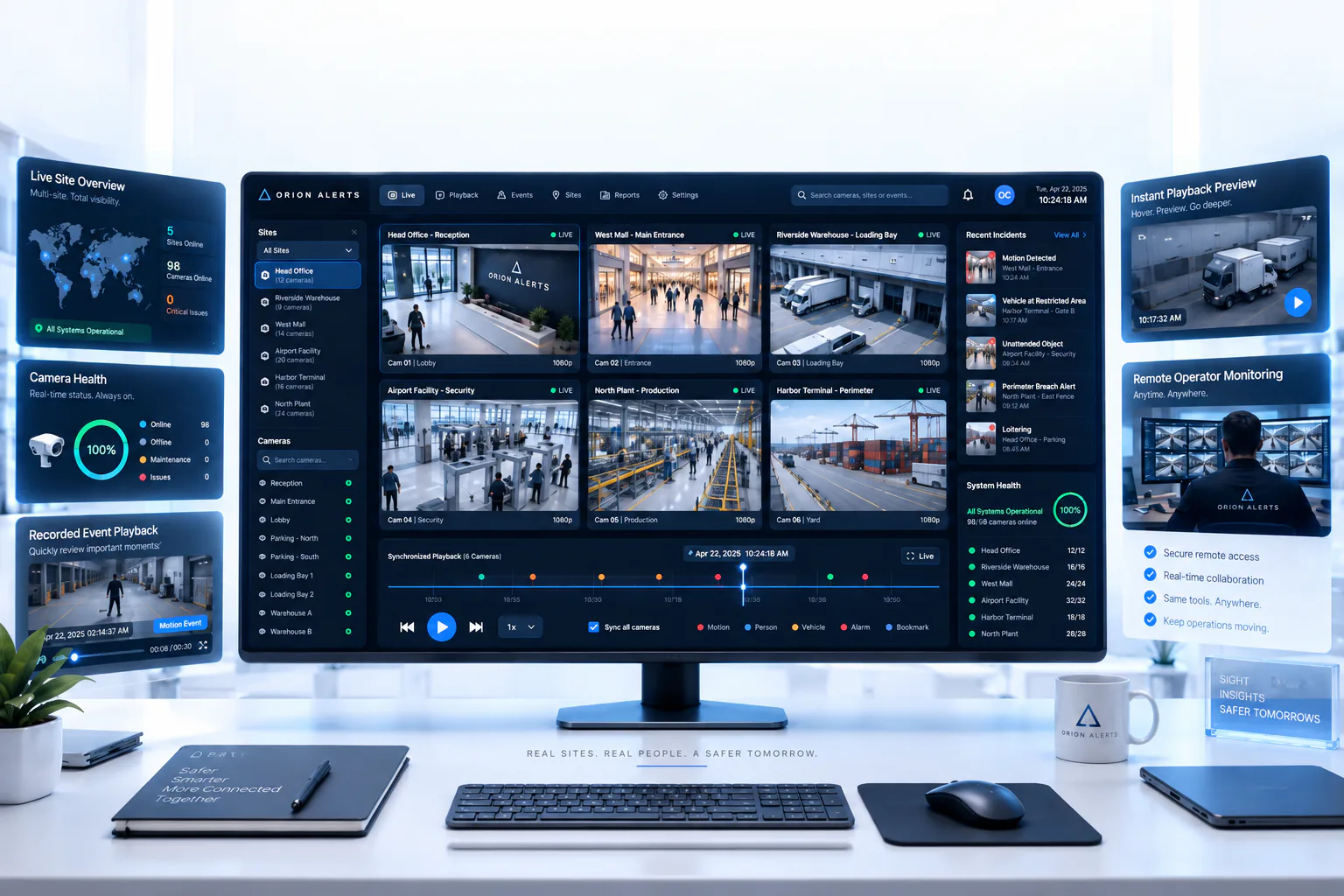
Key takeaways
- 01OrionAlerts connects compatible CP Plus cameras and DVR/NVR environments, including STQC-certified models, through the API engine in Nebula OS.
- 02The CP Plus NVR can keep recording while an on-site OrionAlerts node runs detection and alerting.
- 03Compatibility is confirmed model by model: firmware, available streams and supported interfaces differ across device generations.
- 04Rollout can be phased: keep working cameras, upgrade only where needed and add analytics in software.
Short answer: Yes, you can add AI video analytics to many existing CP Plus cameras without replacing them. OrionAlerts connects compatible CP Plus cameras and recorders through the API engine in Nebula OS, runs detection on an on-site node and sends real-time alerts to the dashboard, mobile app and email, while your NVR can keep recording.
CP Plus cameras are widely installed across Indian businesses and institutions, and most are used the way CCTV has always been used: live viewing, recording and playback after an incident. Adding analytics lets the same cameras flag events while there is still time to respond.
OrionAlerts is built by Global Ace Technology Pvt. Ltd., Mumbai, and is a technology partner of CP Plus. This article explains how the integration works, which devices qualify and how to roll it out.
CP Plus offers a broad surveillance portfolio, including analog and IP cameras, recorders and encoders. In this setup, the cameras capture video, the recorder can continue to store it, and an on-site OrionAlerts node analyzes selected streams in real time and turns events into alerts.
Can OrionAlerts work with existing CP Plus cameras?
Yes, in many cases. Where installed CP Plus devices provide compatible video streams or supported interfaces, OrionAlerts can analyze those feeds on its on-site node.
CP Plus cameras are common in schools, factories, hospitals, offices, warehouses, residential premises and public infrastructure. Many still provide reliable video but are only watched live or reviewed after an incident.
Replacing a whole camera network just to add AI is expensive and disruptive. Keeping suitable cameras and recorders and adding analytics on top avoids unnecessary hardware replacement and gets more value from the existing investment. For the general approach, see how to add AI to existing CCTV cameras.
How does the API engine connect CP Plus devices?
The API engine in Nebula OS gives compatible CP Plus devices one central connection layer, so they can be managed and used for different AI applications instead of being treated as isolated devices.
Depending on the camera model, firmware, available stream and supported integration method, OrionAlerts can work with:
- Existing or older CP Plus IP cameras, and newly installed ones
- Compatible CP Plus DVR and NVR environments
- STQC-certified CP Plus network cameras
- Mixed deployments with different generations of CP Plus devices
- Multi-site installations managed from one platform
Compatibility is assessed model by model, because available APIs, protocols, stream formats and firmware capabilities differ between older and newer devices. Alongside the API engine, the Nebula OS device layer connects cameras over ONVIF and RTSP, and through vendor SDKs where they are supported.
What about STQC-certified cameras?
OrionAlerts can analyze compatible video streams from STQC-certified CP Plus devices; the exact model, firmware and integration configuration are validated during solution design. The certification belongs to the camera: it does not certify OrionAlerts or the system as a whole.
STQC (Standardisation Testing and Quality Certification) is a directorate of India's Ministry of Electronics and Information Technology (MeitY). Its IoT System Certification Scheme includes the certification of CCTV cameras, and STQC publishes its certified-product lists online. CP Plus, a brand of Aditya Infotech Limited, has announced STQC certification for ranges of its IP and PTZ cameras.
STQC certification applies to specific models, firmware versions and evaluated configurations, so verify it against the exact model being proposed or deployed. In this setup, the camera remains responsible for capturing and transmitting video securely, while OrionAlerts analyzes selected feeds for the configured use cases.
Which AI use cases can run on CP Plus streams?
A compatible CP Plus stream can support one or more AI use cases, depending on camera position, video quality, processing capacity and site requirements.
Intrusion and Restricted-Area Detection
Receive an alert when a person enters a configured restricted, hazardous or unauthorized zone.
Perimeter Monitoring
Flag a person crossing or approaching compound walls, gates and other sensitive boundaries with perimeter intrusion detection.
Loitering Detection
Detect when an individual remains in a defined location beyond an allowed duration.
Fire and Smoke Detection
Use video analytics as an additional early-warning layer for visible fire or smoke, alongside certified fire detection and alarm systems, not instead of them.
Fall Detection
Identify possible falls in staircases, corridors, healthcare facilities and industrial areas.
Crowd and Occupancy Monitoring
Monitor crowd formation, occupancy levels and congestion in selected areas.
Vehicle Detection
Monitor vehicle presence and movement at gates, docks and restricted approaches.
Camera Tampering and Health Alerts
Detect a blocked view, a significant scene change, a black screen, a stream interruption or a prolonged lack of expected activity, and track device status with camera health monitoring.
Operational Compliance
Monitor selected processes, such as safety-equipment usage, queue build-up or movement into operational areas.
Accuracy depends on camera placement, lighting, resolution, scene conditions and the use case being deployed, so each camera view is assessed during solution design.
Why use a dedicated AI node instead of only an NVR?
An NVR is built to record and play back video; an AI node is built to analyze many streams continuously and turn events into alerts.
The NVR remains an important part of the system, but its core job is recording, not running a broad and evolving set of AI applications. A dedicated OrionAlerts node adds:
- Analysis of multiple CP Plus camera streams in one place
- Real-time alerts instead of investigation only after an incident
- New analytics added in software rather than with new cameras
- GPU-accelerated processing sized to the channel count and the detections running
- Less need to replace cameras for each new requirement
The NVR can keep recording while the OrionAlerts node handles analysis and alerts. Our VMS vs NVR guide explains where each fits.
How do alerts reach the right team?
Detected events become alerts on the OrionAlerts dashboard, the mobile app and email, and operators can acknowledge and escalate them from one shared queue.
An alert is only valuable when it reaches the right person and leads to a response. The platform can be configured to:
- Send dashboard, mobile app and email notifications
- Escalate to designated teams
- Attach the video clip to each alert so responders can see what happened
- Connect with access control and other third-party systems through the API engine, where those integrations are scoped
- Keep event history with audit-ready access and export trails
That makes the integration useful not only for security, but also for safety, administration and operations teams.
How should you roll it out across sites?
Start with the cameras and use cases that matter most, prove them in a pilot, then extend the same rules to more cameras and locations.
For organizations with many branches or campuses, managing every NVR separately becomes difficult. Each site runs its own OrionAlerts node for video and analytics, and Orion Cloud gives one view of alerts and camera health across locations, so you can apply common AI rules and standardize incident response without uploading raw video.
The approach rests on three principles:
- 1Keep what works. Compatible existing CP Plus cameras and recorders remain part of the system.
- 2Upgrade where needed. STQC-certified or newer CP Plus devices can be added where a site needs newer specifications, certified devices or better image quality.
- 3Add analytics in software. The API engine and AI runtime on the OrionAlerts node add analytics without building intelligence into every camera.
Before a rollout, the OrionAlerts team assesses your camera models, available streams and protocols, NVR and storage setup, network capacity and the AI use cases you need, then plans a phased implementation.
Book a demo to see AI video analytics on your CP Plus cameras.
FAQs
Can OrionAlerts work with existing CP Plus cameras?
Yes, with many compatible CP Plus IP cameras and recorders. OrionAlerts connects them through the API engine in Nebula OS, alongside ONVIF, RTSP and vendor SDKs. Compatibility depends on the exact model, firmware, stream availability, protocol support, network configuration and AI use case, and is confirmed model by model during solution design.
Does every old CP Plus camera support OrionAlerts?
Not necessarily. Older devices are evaluated individually. Some provide suitable streams or integration interfaces as they are, while others need a configuration change, a stream taken from the recorder or an encoder, or replacement. A camera survey before rollout shows which devices can be kept and which cannot.
Can OrionAlerts work with STQC-certified CP Plus cameras?
Yes, where the device provides a compatible stream. OrionAlerts can analyze video from STQC-certified CP Plus cameras, with the exact model, firmware and integration configuration validated during solution design. The certification applies to the camera itself; it does not certify OrionAlerts or the system as a whole.
Does OrionAlerts replace the CP Plus NVR?
Not necessarily. The existing NVR can keep recording while OrionAlerts runs analytics and alert management on its on-site node. Whether recording later moves to the OrionAlerts platform depends on the age of the recorders, your retention needs and how the rollout is phased, and is decided during solution design.
Can one CP Plus camera run multiple AI analytics?
Often, yes. One camera view can support several detections, such as intrusion and loitering in the same area. The number and type depend on the view, image quality, frame rate, processing capacity on the node and whether the use cases suit the same scene, so each combination is checked during the pilot.
Is OrionAlerts limited to security alerts?
No. Besides intrusion and perimeter alerts, the same CP Plus cameras can support safety use cases such as PPE compliance and fall detection, operational ones such as crowd and occupancy, and camera health checks. Asset tracking and AMC management can also cover the cameras and recorders themselves, with their warranties and service history.
Can OrionAlerts integrate with third-party software?
Yes, where the integration is scoped for your sites. Nebula OS includes an API engine for connecting OrionAlerts with existing NVRs, VMS platforms, access control systems and enterprise applications. Which integrations a deployment needs is agreed during solution design rather than assumed up front.
Keep reading
Related articles
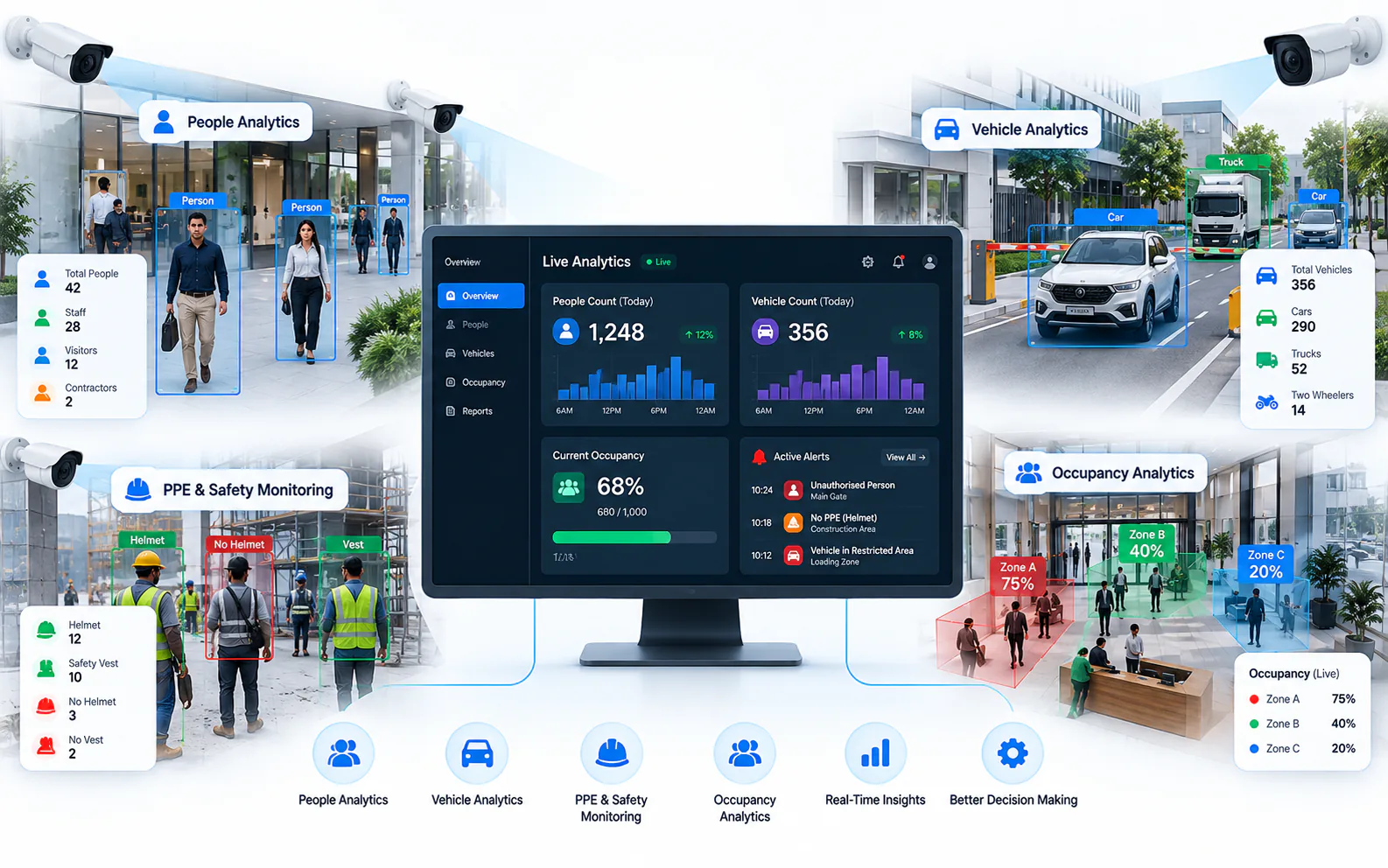
AI Video Analytics · 26 Oct 2026 · 8 min read
How to Add AI to Existing CCTV Cameras Without Replacing Them
Add AI video analytics to the CCTV cameras you already own: compatibility checks, ONVIF and RTSP, edge vs cloud processing and a pilot-first rollout.
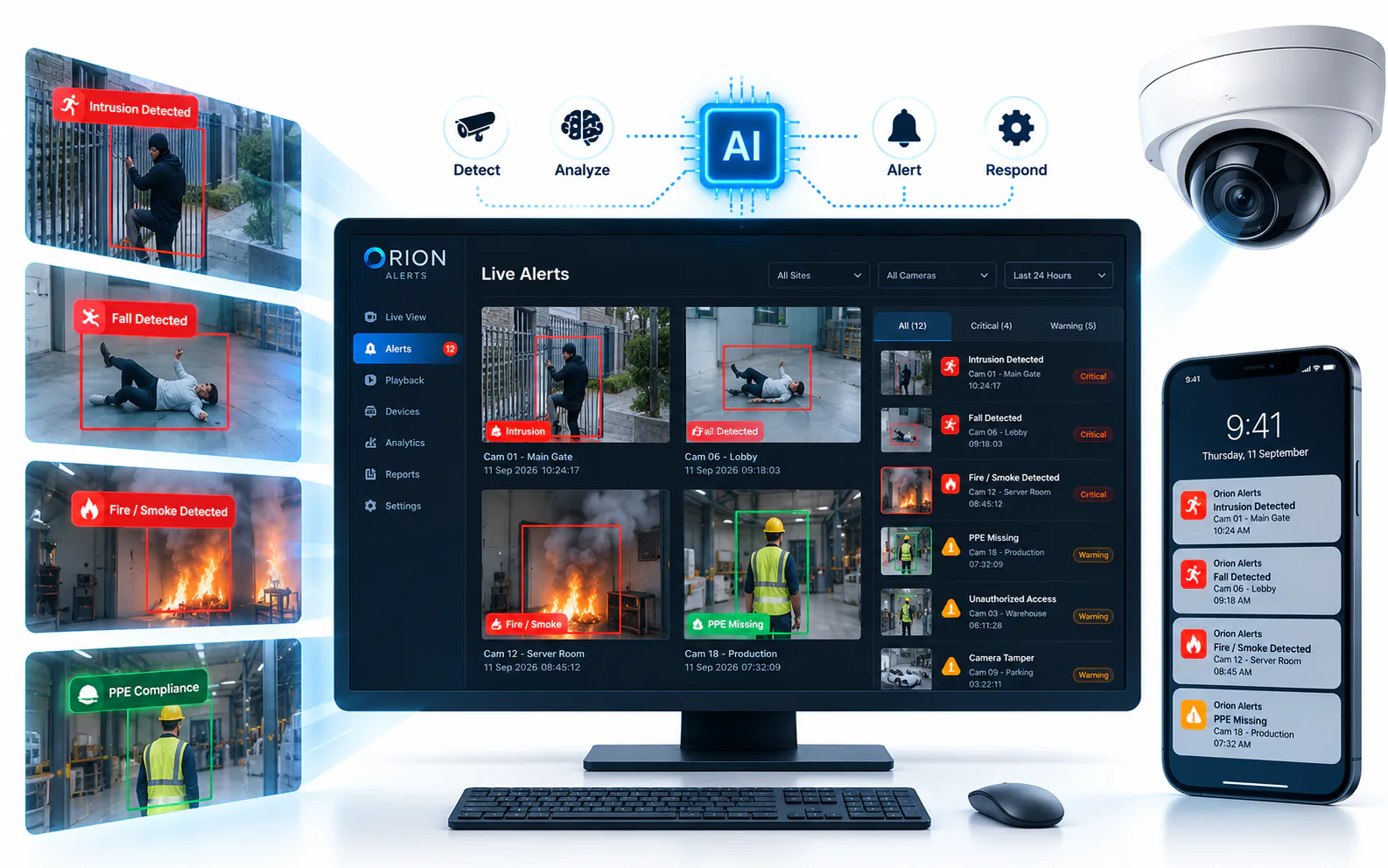
AI Video Analytics · 26 Oct 2026 · 9 min read
AI Video Analytics Buyer's Guide: How to Evaluate Vendors
How to evaluate AI video analytics vendors: existing-camera support, edge or cloud inference, data residency, multi-site control, pilots and support.